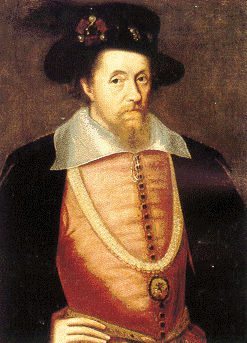
Saturday, May 9, 2009

Basilikon Doron

In the paragraph that spans pages 75 and 76, our tour guide gives us a picture of James VI of Scotland that will help us when we meet him later as James I of England.
Strangely, Gardiner gives short shrift to the one document that is probably the most revealing of James's character: a treatise that that king wrote for the instruction of his son, Prince Henry, called Basilikon Doron.
For the most part, this book contains sound, if at times shallow, advice on the right behavior of a king towards God, his state and his people. But when it became known outside the royal family (it was not originally intended for publication, and originally only seven copies were printed), the Doron was criticized on many points by "the Godly sort". The chief problem was that James derived all his views of kingship from one basic principle: That kings derive their authority directly from God. He assumed that this fact gave him broad power, authority, even wisdom, in matters of religion. And this assumption could not go unchallenged by the ministers, who were among the few people in Scotland who could actually read a book.
To blunt the criticism, the king released the Doron for publication in 1599. He included a Preface "To the Reader" in which he tried to justify himself. If you read no other part of the book, read those nine pages because they reveal the internal logic that will govern James's decisions for the next 25 years: that he is "steadfast, true and plain", with a special mandate from God; and that those who oppose him either misunderstand or are driven by personal motives.
The introductory sonnet summarizes Basilikon Doron, and although it is well known, perhaps it will not be out of place here as a reminder:
God gives not kings the style of gods in vain,
For on the throne His sceptre do they sway;
And as their subjects ought them to obey,
So kings should fear and serve their God again.
If, then, ye would enjoy a happy reign,
Observe the statutes of our heavenly king,
And from His law make all your laws to spring.
If His lieutenant here you would remain,
Reward the just, be steadfast, true, and plain;
Repress the proud, maintaining aye the right;
Walk always so as ever in His sight,
Who guards the godly, plaguing the profane;
And so shall you in princely virtues shine,
Resembling right your mighty King divine.


Monday, May 4, 2009

17th-century Equivalant to Las Vegas


I apologize for being a tardy blogger. Last week I was at technology meeting in Las Vegas. It got me thinking what the 17th-century analog of Las Vegas might be. What are the main characteristics of Las Vegas?
  1. Large crowds of people aware only of themselves.
  2. Prices beyond the reach of most, but so persistent that people pay or go hungry.
  3. Temptations so artfully decorated that victims recognize their folly only as it consumes them.
There is only one 17th-century analog: hell.

Most of what is known about the views of the English and Scots on the subject of Hell comes from entertainments--plays like Marlowe's Faust. A study of contemporary ecclesiastical sources on the nature of the "other place" would be rewarding, I think. I admit that the underworld the poets portray does not have the surface attraction of Las Vegas, but the theme of selfish denizens condemned by their own acts to pain and suffering is immediately applicable.

Sunday, April 26, 2009

James VI Loses Control of the Church


I'm going to gloss over pages 55 through 75. You should not skip over them: they are important if you are to understand the religious climate when we finally begin our tour. These pages cover in some detail the missteps of the Scottish government which led to the Kirk becoming a potent independent political power. My reasons for not dealing with these transactions in detail are that the mistakes in government are the same we have seen James make in the past and that he will make in the future; that the causes are not nearly as important as the results; and that in hindsight, the results are easy to foresee.

Gardiner comes to three important conclusions about this period, which spans approximately 1594-1601:
  1. That the General Assembly of the Kirk was in a way a substitute for the exercise of political influence by the non-titled wealthy classes.
  2. That this political influence served as a curb on the tendency of the nobility to preserve their feudal dominance.
  3. That liberty of speech from the pulpit was a key factor in the development of a politically sound and unified Scotland.

We will need to keep in mind that these results occurred in spite of King James.

Because this is such a big span of pages, I'll delay the next post to let you digest it. I will be at Microsoft Management Summit next week, anyway, so another blog post in April in unlikely.

The portrait above is of James Beaton, the Archbishop of Glasgow during the period covered by today's post.

Tuesday, April 21, 2009

Sometimes we're still arguing about the same things

Yesterday's post that touched lightly on church government put me in mind of a statement I made early in this blog: that passions about the controversies of 17th-century Britain are largely exhausted now. That statement does not apply to Ireland, and there are probably broad exceptions in the rest of the English-speaking world.

It was reading reading the tail end of Arthur Bryant's 3-volume biography of Samuel Pepys that provoked me to this entry, though. Bryant, writing about a period 90 years after the era into which we are preparing to dip our toes, naturally took a position in support of his hero, the Secretary of the Admiralty, Mr. Pepys. In doing so, he re-introduced, in the 1930s, some arguments that have been simmering (sometimes raging) since 1610. Bryant confidently assumes a Tory stance. By doing so, he automatically (and apparently with his eyes open) puts himself into angry disagreement with Whigs like Macaulay; and makes violent accusations against the ebablers of the Glorious Revolution of 1688.

There is no doubt that serious charges can be proved against the lords, lawyers and bishops who brought William of Orange to the British crowns. In many ways, they were a scummy lot. But the same can be said for the sycophants and infidels who suppported the rightful king, James Stuart and his foreign-driven religious policy. My point is that we are still not over it. Seventy years ago Bryant could work himself into a (for a Tory) frenzy about some of the same issues that excited the English and Scots in 17th century.
I think that if you turn on AM radio in Central Texas tomorrow you will hear people work themselves into frenzies over very similar arguments.

This brief revery encourages me, because I think our walk in 17th-century Britain may occasionally be topical as well as interesting.

Monday, April 20, 2009

James VI and Andrew Melville

Pages 48 to 56 deserve to be read carefully, if only because they predict many of the problems the Stuart kings will have over the next 90 years. Central in the conflict between King James VI of Scotland--soon to be a focus of our tour in England--and his Scots church is Andrew Melville, the proto-Presbyterian.

It is difficult to reconcile Gardiner's view of Melville as "the Presbyterian leader of the day, with a mind narrower than that of Knox, the champion of a system rather than a spiritual guide"; with the opposite opinion (see the link) that he was far more interested in matters of faith than of government. The conflicting conclusions probably reflect the man's complexity.

There is nothing so prophetic of the Stuarts' fate as Melville telling King James to his face that he was "God's silly vassal." ("Silly" meant weak and foolish.)

James Melville was the most advanced Scots scholar of his time. He was one of a handful of Scotsmen who could read Greek. His reputation as a scholar in France and Switzerland spanned religious boundaries. He is deservedly considered the founder of Scotland's reputation for learning.

Note two links in the linked article on Melville: first the article on his nephew, James Melville, himself a considerable scholar and presbyterian founder; and second the article on Robert Browne, the seperationist who is considered the father of Congregationalism.

Next time we'll take a look at the key weakness of the Scots clergy in the 150s: the political nature of their key grievances. I hope I won't spoil the tour by revealing that this weakness will gradually become at least a temporary strength. If you feel like reading ahead, begin at page 55.

Saturday, April 4, 2009

The Character of James I


We now come to a figure whose person or shadow we will encounter at almost every step of our walking tour. James VI of Scotland became King James the first of England on the death of Queen Elizabeth. As king his weaknesses and strengths--for he had both--were multiplied in effect. If, as Heraclitus says, character is destiny, then a king's character is his kingdom's destiny.

Fortunately we know quite a bit about James I, from his own writings and from comments written by observant and probably trustworthy contemporaries. Our tour guide has read it all and digests it beginning at the bottom of page 48.

Gardiner foreshadows here, a technique not always appropriate in a history, but used to good effect here. He shows that the character of the king made it almost impossible for him to deal with the religio-political situation he is inheriting. On plus side, James was intelligent, intellectually curious, and--for a monarch--well-educated. (Most branches of learning were not considered useful to a king.) But he was vane, dogmatic, a poor judge of character, and showed a flaw that Gardiner sometimes shares: a difficulty in judging what is important and what is not. Gardiner shows these defects led to intolerance in government even though James himself was a tolerant man. Expect to see the effects of this blog-by-blog for a considerable time.

Note that this is not a comprehensive assessment of James's character. Gardiner will return to the subject several times. It is enough of an introduction, however, to explain the development of relations betwwen the king and the Scottish clergy (pages 49-51), the Scots feudal nobility (pages 51-53), and the corporate Presbyterian Kirk (pages 53-55).

Next time we will look at a case that shows some of the conflicts exacerbated by James's character: Black's case. If you want to read ahead, it starts at the bottom of page 56.

Wednesday, April 1, 2009

Before we can get our tour into full swing, our tour guide thinks we need a little more background. In particular, he wants us to keep in mind the fundamental differences in the religious landscapes of England and Scotland, and the inherent inability of the king of both to deal with the consequent political problems of either.

Read the beginning of Chapter 2: pages 44-49. Gardiner succinctly shows us an England where the Church was a fulcrum balancing the challenges posed by Catholics on one side and puritans on the other. He contracts this with Scotland, where, under James VI, the Church quickly became exclusively associated with the equivalent of the puritan party. The Presbyterian Second Book of Discipline, which Gardiner mentions, is a Calvinist constitution.

Why should we tourists care about this? It is because, as Gardiner says, in those days every religious question was also a political one. And as Presbyterian ideas become more visible in the landscape, we will see their effects on the countries through which we tour. After all, the Book of Discipline says

It is proper to kings, princes, and magistrates to be called lords and dominators over their subjects, whom they govern civilly, but it is proper to Christ only to be called Lord and Master in the spiritual government of the kirk....

And if that idea takes hold south of Tweed, it will change the landscape considerabily.