Monday, September 28, 2009
James I and Catholicism, on his accession
One the the best-known of Gardiner's assertions about James I is on page 82: that "he was unwilling that the blood of any man should be shed for diversity of opinion in religion." The assertion is very plausible for the period before the Gunpower Treason, but, although we will see echos of the sentiment until James's death, the king was not strongly married to this point of view.


Wednesday, September 23, 2009
Succession
Picking up around page 78, Gardiner talks about the candidates to succeed Queen Elizabeth. The best discussion of this topic, I think, is in the introduction to The Correspondence of James VI with Robert Cecil.
The law was fairly clear: succession as settled by Henry VIII would be through his male line. When that failed, Mary (originally excluded as illegitimate) and then Elizabeth, his daughters should succeed. The provision for the failing of all three lines was descent to the "rightful heirs" of Henry VIII. Determining the next "rightful heir" was the sticking point. The king tried to help by inserting in his will that if his line should fail, descent would be through his niece, Francis; then his niece Eleanor; then the next "rightful heirs." The possible heirs in these lines were Edward, Lord Beauchamp; and the Earl of Derby.
Hereditary was politically important in European politics. It was the least costly and least violent way of transferring power. The uncertainty of reproduction undoubtedly made Henry VIII make these complicating provisions, but in fact peoples' idea of "right inheritance" would provide strong contradictory arguments. And by the rules recognized at the time, the nearest heir was James, the grandson of Henry VII's eldest daughter, Margaret. The closest descendent who was an English subject was Arbella Stuart, also in Margaret's line.
There were objections against all these candidates, but there were no more descendants of Henry VII. Others were proposed as descending from Edward III or even earlier kings, but these were mainly foreigners. In the end, the choice was left to Queen Elizabeth, as we will learn, and she may or may not have designated King James. The English hierarchy accepted him as the least tainted of the available choices.
The law was fairly clear: succession as settled by Henry VIII would be through his male line. When that failed, Mary (originally excluded as illegitimate) and then Elizabeth, his daughters should succeed. The provision for the failing of all three lines was descent to the "rightful heirs" of Henry VIII. Determining the next "rightful heir" was the sticking point. The king tried to help by inserting in his will that if his line should fail, descent would be through his niece, Francis; then his niece Eleanor; then the next "rightful heirs." The possible heirs in these lines were Edward, Lord Beauchamp; and the Earl of Derby.
Hereditary was politically important in European politics. It was the least costly and least violent way of transferring power. The uncertainty of reproduction undoubtedly made Henry VIII make these complicating provisions, but in fact peoples' idea of "right inheritance" would provide strong contradictory arguments. And by the rules recognized at the time, the nearest heir was James, the grandson of Henry VII's eldest daughter, Margaret. The closest descendent who was an English subject was Arbella Stuart, also in Margaret's line.
There were objections against all these candidates, but there were no more descendants of Henry VII. Others were proposed as descending from Edward III or even earlier kings, but these were mainly foreigners. In the end, the choice was left to Queen Elizabeth, as we will learn, and she may or may not have designated King James. The English hierarchy accepted him as the least tainted of the available choices.
Wednesday, June 17, 2009
Skipping ahead a bit
I apologize for a derth of posting. For reasons unrelated to this blog, I was working on a document related to events 25 years after the current period of the tour.
You may still want to look at it, though. It's at http://bob.fooguru.org/content/herbert/index.html
You may still want to look at it, though. It's at http://bob.fooguru.org/content/herbert/index.html
Saturday, May 23, 2009
Asynchronisity again
I've been reading a very dreary, imperfect and badly edited biography of Sir Walter Raleigh--the most recent one, by Raleigh Trevelyan--and came across a reference to the fight of Raleigh's ship Revenge with the Spanish fleet at Flores in the Azores in 1591. The battle is famous--perhaps the best known "against all odds" story in English history--and was documented by Raleigh in what is probably the first printed piece of popular propaganda in English history; but I was totally unaware of Alfred, Lord Tennyson's much later poem on the subject. In a strange way, the poem drives home Raleigh's point better than he did himself.
It seems strange to me that our tour guide didn't mention this incident (although he stressed the defeat of the Armada 3 years before), because this incident--especially as decorated by Raleigh and interpreted by Tennyson--graphically explains the attitude of many Englishmen towards the Spanish. That attitude will come to the fore when reach the 1620s.
It seems strange to me that our tour guide didn't mention this incident (although he stressed the defeat of the Armada 3 years before), because this incident--especially as decorated by Raleigh and interpreted by Tennyson--graphically explains the attitude of many Englishmen towards the Spanish. That attitude will come to the fore when reach the 1620s.
Saturday, May 16, 2009
The Gowrie Conspiracy
On page 76, our tour guide passes over with no comment the curious affair of the Gowrie Plot. Over the period of several hours on August 5, 1600, the King of Scotland was easily captured by a supposedly rebel lord—the Earl of Gowrie—and just as easily escaped. The events of the day are confusing and several interpretations may be laid on them.
In brief, Alexander Ruthven, the young brother of the Earl of Gowrie, convinced James, who was in the field hunting, to accompany Ruthven to Gowrie House in Perth. The story he is supposed to have given the king is that he had captured a vagrant carrying a pot of gold. When they arrived in Perth, Ruthven conducted the king to a tower room in which was a tall armed man. Ruthven left James there, locking the door behind him; and told the king's party, coming later, that the King had already left Perth. Some time later, the king shouted from a window in his room. His attendants rushed the tower, killing Ruthven, and James was freed unharmed.
There are three broad interpretations of these events:
Why is this important (especially given that our tour guide does not find it so)? It is not because if insight it gives us on James's character--clearly the evidence is ambiguous whether the king in this case was
In brief, Alexander Ruthven, the young brother of the Earl of Gowrie, convinced James, who was in the field hunting, to accompany Ruthven to Gowrie House in Perth. The story he is supposed to have given the king is that he had captured a vagrant carrying a pot of gold. When they arrived in Perth, Ruthven conducted the king to a tower room in which was a tall armed man. Ruthven left James there, locking the door behind him; and told the king's party, coming later, that the King had already left Perth. Some time later, the king shouted from a window in his room. His attendants rushed the tower, killing Ruthven, and James was freed unharmed.
There are three broad interpretations of these events:
- That there was a plot by Ruthven, or Gowrie and Ruthven, to kidnap and/or kill the king.
- That it was a plot by the king to ruin the Ruthvens, whom he viewed as dangerous to his throne.
- That it was just a misunderstanding that was blown out of proportion.
Why is this important (especially given that our tour guide does not find it so)? It is not because if insight it gives us on James's character--clearly the evidence is ambiguous whether the king in this case was
- Greedy and gullible, or
- Crafty and vengeful, or
- Careless and ill-tempered
Saturday, May 9, 2009
Basilikon Doron
In the paragraph that spans pages 75 and 76, our tour guide gives us a picture of James VI of Scotland that will help us when we meet him later as James I of England.
Strangely, Gardiner gives short shrift to the one document that is probably the most revealing of James's character: a treatise that that king wrote for the instruction of his son, Prince Henry, called Basilikon Doron.
For the most part, this book contains sound, if at times shallow, advice on the right behavior of a king towards God, his state and his people. But when it became known outside the royal family (it was not originally intended for publication, and originally only seven copies were printed), the Doron was criticized on many points by "the Godly sort". The chief problem was that James derived all his views of kingship from one basic principle: That kings derive their authority directly from God. He assumed that this fact gave him broad power, authority, even wisdom, in matters of religion. And this assumption could not go unchallenged by the ministers, who were among the few people in Scotland who could actually read a book.
To blunt the criticism, the king released the Doron for publication in 1599. He included a Preface "To the Reader" in which he tried to justify himself. If you read no other part of the book, read those nine pages because they reveal the internal logic that will govern James's decisions for the next 25 years: that he is "steadfast, true and plain", with a special mandate from God; and that those who oppose him either misunderstand or are driven by personal motives.
The introductory sonnet summarizes Basilikon Doron, and although it is well known, perhaps it will not be out of place here as a reminder:
Strangely, Gardiner gives short shrift to the one document that is probably the most revealing of James's character: a treatise that that king wrote for the instruction of his son, Prince Henry, called Basilikon Doron.
For the most part, this book contains sound, if at times shallow, advice on the right behavior of a king towards God, his state and his people. But when it became known outside the royal family (it was not originally intended for publication, and originally only seven copies were printed), the Doron was criticized on many points by "the Godly sort". The chief problem was that James derived all his views of kingship from one basic principle: That kings derive their authority directly from God. He assumed that this fact gave him broad power, authority, even wisdom, in matters of religion. And this assumption could not go unchallenged by the ministers, who were among the few people in Scotland who could actually read a book.
To blunt the criticism, the king released the Doron for publication in 1599. He included a Preface "To the Reader" in which he tried to justify himself. If you read no other part of the book, read those nine pages because they reveal the internal logic that will govern James's decisions for the next 25 years: that he is "steadfast, true and plain", with a special mandate from God; and that those who oppose him either misunderstand or are driven by personal motives.
The introductory sonnet summarizes Basilikon Doron, and although it is well known, perhaps it will not be out of place here as a reminder:
God gives not kings the style of gods in vain,
For on the throne His sceptre do they sway;
And as their subjects ought them to obey,
So kings should fear and serve their God again.
If, then, ye would enjoy a happy reign,
Observe the statutes of our heavenly king,
And from His law make all your laws to spring.
If His lieutenant here you would remain,
Reward the just, be steadfast, true, and plain;
Repress the proud, maintaining aye the right;
Walk always so as ever in His sight,
Who guards the godly, plaguing the profane;
And so shall you in princely virtues shine,
Resembling right your mighty King divine.
Monday, May 4, 2009
17th-century Equivalant to Las Vegas

I apologize for being a tardy blogger. Last week I was at technology meeting in Las Vegas. It got me thinking what the 17th-century analog of Las Vegas might be. What are the main characteristics of Las Vegas?
- Large crowds of people aware only of themselves.
- Prices beyond the reach of most, but so persistent that people pay or go hungry.
- Temptations so artfully decorated that victims recognize their folly only as it consumes them.
Most of what is known about the views of the English and Scots on the subject of Hell comes from entertainments--plays like Marlowe's Faust. A study of contemporary ecclesiastical sources on the nature of the "other place" would be rewarding, I think. I admit that the underworld the poets portray does not have the surface attraction of Las Vegas, but the theme of selfish denizens condemned by their own acts to pain and suffering is immediately applicable.
Sunday, April 26, 2009
James VI Loses Control of the Church

I'm going to gloss over pages 55 through 75. You should not skip over them: they are important if you are to understand the religious climate when we finally begin our tour. These pages cover in some detail the missteps of the Scottish government which led to the Kirk becoming a potent independent political power. My reasons for not dealing with these transactions in detail are that the mistakes in government are the same we have seen James make in the past and that he will make in the future; that the causes are not nearly as important as the results; and that in hindsight, the results are easy to foresee.
Gardiner comes to three important conclusions about this period, which spans approximately 1594-1601:
- That the General Assembly of the Kirk was in a way a substitute for the exercise of political influence by the non-titled wealthy classes.
- That this political influence served as a curb on the tendency of the nobility to preserve their feudal dominance.
- That liberty of speech from the pulpit was a key factor in the development of a politically sound and unified Scotland.
We will need to keep in mind that these results occurred in spite of King James.
Because this is such a big span of pages, I'll delay the next post to let you digest it. I will be at Microsoft Management Summit next week, anyway, so another blog post in April in unlikely.
The portrait above is of James Beaton, the Archbishop of Glasgow during the period covered by today's post.

Tuesday, April 21, 2009
Sometimes we're still arguing about the same things
Yesterday's post that touched lightly on church government put me in mind of a statement I made early in this blog: that passions about the controversies of 17th-century Britain are largely exhausted now. That statement does not apply to Ireland, and there are probably broad exceptions in the rest of the English-speaking world.
It was reading reading the tail end of Arthur Bryant's 3-volume biography of Samuel Pepys that provoked me to this entry, though. Bryant, writing about a period 90 years after the era into which we are preparing to dip our toes, naturally took a position in support of his hero, the Secretary of the Admiralty, Mr. Pepys. In doing so, he re-introduced, in the 1930s, some arguments that have been simmering (sometimes raging) since 1610. Bryant confidently assumes a Tory stance. By doing so, he automatically (and apparently with his eyes open) puts himself into angry disagreement with Whigs like Macaulay; and makes violent accusations against the ebablers of the Glorious Revolution of 1688.
There is no doubt that serious charges can be proved against the lords, lawyers and bishops who brought William of Orange to the British crowns. In many ways, they were a scummy lot. But the same can be said for the sycophants and infidels who suppported the rightful king, James Stuart and his foreign-driven religious policy. My point is that we are still not over it. Seventy years ago Bryant could work himself into a (for a Tory) frenzy about some of the same issues that excited the English and Scots in 17th century.
I think that if you turn on AM radio in Central Texas tomorrow you will hear people work themselves into frenzies over very similar arguments.
This brief revery encourages me, because I think our walk in 17th-century Britain may occasionally be topical as well as interesting.
It was reading reading the tail end of Arthur Bryant's 3-volume biography of Samuel Pepys that provoked me to this entry, though. Bryant, writing about a period 90 years after the era into which we are preparing to dip our toes, naturally took a position in support of his hero, the Secretary of the Admiralty, Mr. Pepys. In doing so, he re-introduced, in the 1930s, some arguments that have been simmering (sometimes raging) since 1610. Bryant confidently assumes a Tory stance. By doing so, he automatically (and apparently with his eyes open) puts himself into angry disagreement with Whigs like Macaulay; and makes violent accusations against the ebablers of the Glorious Revolution of 1688.
There is no doubt that serious charges can be proved against the lords, lawyers and bishops who brought William of Orange to the British crowns. In many ways, they were a scummy lot. But the same can be said for the sycophants and infidels who suppported the rightful king, James Stuart and his foreign-driven religious policy. My point is that we are still not over it. Seventy years ago Bryant could work himself into a (for a Tory) frenzy about some of the same issues that excited the English and Scots in 17th century.
I think that if you turn on AM radio in Central Texas tomorrow you will hear people work themselves into frenzies over very similar arguments.
This brief revery encourages me, because I think our walk in 17th-century Britain may occasionally be topical as well as interesting.
Monday, April 20, 2009
James VI and Andrew Melville
Pages 48 to 56 deserve to be read carefully, if only because they predict many of the problems the Stuart kings will have over the next 90 years. Central in the conflict between King James VI of Scotland--soon to be a focus of our tour in England--and his Scots church is Andrew Melville, the proto-Presbyterian.
It is difficult to reconcile Gardiner's view of Melville as "the Presbyterian leader of the day, with a mind narrower than that of Knox, the champion of a system rather than a spiritual guide"; with the opposite opinion (see the link) that he was far more interested in matters of faith than of government. The conflicting conclusions probably reflect the man's complexity.
There is nothing so prophetic of the Stuarts' fate as Melville telling King James to his face that he was "God's silly vassal." ("Silly" meant weak and foolish.)
James Melville was the most advanced Scots scholar of his time. He was one of a handful of Scotsmen who could read Greek. His reputation as a scholar in France and Switzerland spanned religious boundaries. He is deservedly considered the founder of Scotland's reputation for learning.
Note two links in the linked article on Melville: first the article on his nephew, James Melville, himself a considerable scholar and presbyterian founder; and second the article on Robert Browne, the seperationist who is considered the father of Congregationalism.
Next time we'll take a look at the key weakness of the Scots clergy in the 150s: the political nature of their key grievances. I hope I won't spoil the tour by revealing that this weakness will gradually become at least a temporary strength. If you feel like reading ahead, begin at page 55.
It is difficult to reconcile Gardiner's view of Melville as "the Presbyterian leader of the day, with a mind narrower than that of Knox, the champion of a system rather than a spiritual guide"; with the opposite opinion (see the link) that he was far more interested in matters of faith than of government. The conflicting conclusions probably reflect the man's complexity.
There is nothing so prophetic of the Stuarts' fate as Melville telling King James to his face that he was "God's silly vassal." ("Silly" meant weak and foolish.)
James Melville was the most advanced Scots scholar of his time. He was one of a handful of Scotsmen who could read Greek. His reputation as a scholar in France and Switzerland spanned religious boundaries. He is deservedly considered the founder of Scotland's reputation for learning.
Note two links in the linked article on Melville: first the article on his nephew, James Melville, himself a considerable scholar and presbyterian founder; and second the article on Robert Browne, the seperationist who is considered the father of Congregationalism.
Next time we'll take a look at the key weakness of the Scots clergy in the 150s: the political nature of their key grievances. I hope I won't spoil the tour by revealing that this weakness will gradually become at least a temporary strength. If you feel like reading ahead, begin at page 55.
Saturday, April 4, 2009
The Character of James I
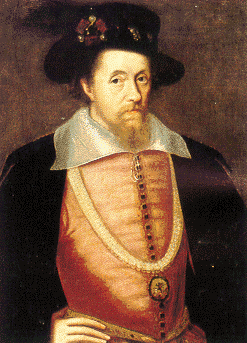
We now come to a figure whose person or shadow we will encounter at almost every step of our walking tour. James VI of Scotland became King James the first of England on the death of Queen Elizabeth. As king his weaknesses and strengths--for he had both--were multiplied in effect. If, as Heraclitus says, character is destiny, then a king's character is his kingdom's destiny.
Fortunately we know quite a bit about James I, from his own writings and from comments written by observant and probably trustworthy contemporaries. Our tour guide has read it all and digests it beginning at the bottom of page 48.
Gardiner foreshadows here, a technique not always appropriate in a history, but used to good effect here. He shows that the character of the king made it almost impossible for him to deal with the religio-political situation he is inheriting. On plus side, James was intelligent, intellectually curious, and--for a monarch--well-educated. (Most branches of learning were not considered useful to a king.) But he was vane, dogmatic, a poor judge of character, and showed a flaw that Gardiner sometimes shares: a difficulty in judging what is important and what is not. Gardiner shows these defects led to intolerance in government even though James himself was a tolerant man. Expect to see the effects of this blog-by-blog for a considerable time.
Note that this is not a comprehensive assessment of James's character. Gardiner will return to the subject several times. It is enough of an introduction, however, to explain the development of relations betwwen the king and the Scottish clergy (pages 49-51), the Scots feudal nobility (pages 51-53), and the corporate Presbyterian Kirk (pages 53-55).
Next time we will look at a case that shows some of the conflicts exacerbated by James's character: Black's case. If you want to read ahead, it starts at the bottom of page 56.
Wednesday, April 1, 2009
Before we can get our tour into full swing, our tour guide thinks we need a little more background. In particular, he wants us to keep in mind the fundamental differences in the religious landscapes of England and Scotland, and the inherent inability of the king of both to deal with the consequent political problems of either.
Read the beginning of Chapter 2: pages 44-49. Gardiner succinctly shows us an England where the Church was a fulcrum balancing the challenges posed by Catholics on one side and puritans on the other. He contracts this with Scotland, where, under James VI, the Church quickly became exclusively associated with the equivalent of the puritan party. The Presbyterian Second Book of Discipline, which Gardiner mentions, is a Calvinist constitution.
Why should we tourists care about this? It is because, as Gardiner says, in those days every religious question was also a political one. And as Presbyterian ideas become more visible in the landscape, we will see their effects on the countries through which we tour. After all, the Book of Discipline says
And if that idea takes hold south of Tweed, it will change the landscape considerabily.
Read the beginning of Chapter 2: pages 44-49. Gardiner succinctly shows us an England where the Church was a fulcrum balancing the challenges posed by Catholics on one side and puritans on the other. He contracts this with Scotland, where, under James VI, the Church quickly became exclusively associated with the equivalent of the puritan party. The Presbyterian Second Book of Discipline, which Gardiner mentions, is a Calvinist constitution.
Why should we tourists care about this? It is because, as Gardiner says, in those days every religious question was also a political one. And as Presbyterian ideas become more visible in the landscape, we will see their effects on the countries through which we tour. After all, the Book of Discipline says
It is proper to kings, princes, and magistrates to be called lords and dominators over their subjects, whom they govern civilly, but it is proper to Christ only to be called Lord and Master in the spiritual government of the kirk....
And if that idea takes hold south of Tweed, it will change the landscape considerabily.
Friday, March 20, 2009

At the end of chapter 1, Gardiner brings us to the death of Queen Elizabeth. He does not spend much time on the controversey of the naming of her successor, James VI of Scotland, which is odd because it is the sort of detail the Gardiner seems to like. In a footnote, he is kind enough to point us to what he considers the most detailed account of the last 2 days of the queen's life, which give me the chance to introduce Isaac Disraeli (1766-1848), the father of the Prime Minister. The elder Disraeli made his living by his pen, and his Curiosities of Literature is a delightful work to browse and a well-researched (in many cases) source of historical anecdote. Gardiner refers us to Disraeli's account of the death of Elizabeth, which I reproduce here:
SECRET HISTORY OF THE DEATH OF QUEEN ELIZABETH.
Source: Disraeli's Curiosities of Literature, Vol. 3, pp 328-332.
It is an extraordinary circumstance in our history, that the accession to the English dominion, in two remarkable cases, was never settled by the possessors of the throne themselves during their lifetime; and that there is every reason to believe that this mighty transfer of three kingdoms became the sole act of their ministers, who considered the succession merely as a state expedient. Two of our most able sovereigns found themselves in this predicament: Queen Elizabeth and the Protector Cromwell! Cromwell probably had his reasons not to name his successor; his positive election would have dissatisfied the opposite parties of his government, whom he only ruled while he was able to cajole them. He must have been aware that latterly he had need of conciliating all parties to his usurpation, and was probably as doubtful on his death-bed whom to appoint his successor as at any other period of his reign. Ludlow suspects that Cromwell was so discomposed in body or mind, that he could not attend to that matter; and whether he named any one is to me uncertain.
All that we know is the report of the Secretary Thurlow and his chaplains, who, when the protector lay in his last agonies, suggested to him the propriety of choosing his eldest son, and they tell us that he agreed to this choice. Had Cromwell been in his senses, he would have probably fixed on Henry, the lord-lieutenant of Ireland, rather than on Richard, or possibly had not chosen either of his sons!
Elizabeth, from womanish infirmity, or from state-reasons, could not endure the thoughts of her successor; and long threw into jeopardy the politics of all the cabinets of Europe, each of which had its favourite candidate to support. The legitimate heir lo the throne of England was to be the creature of her breath, yet Elizabeth would not speak him into existence! This had, however, often raised the discontents of the nation, and we shall see how it harassed the queen in her dying hours. It is even suspected that the queen still retained so much of the woman, that she could never overcome her perverse dislike to name a successor; so that, according to this opinion, she died and left the crown to the mercy of a party! This would have been acting unworthy of the magnanimity of her great character—and as it is ascertained that the queen was very sensible that she lay in a dying state several days before the natural catastrophe occurred, it is difficult to believe that she totally disregarded so important a circumstance. It is therefore, reasoning à priori, most natural to conclude that the choice of a successor must have occupied her thoughts, as well as the anxieties of her ministers; and that she would not have left the throne in the same unsettled state at her death as she had persevered in during her whole life. How did she express herself when bequeathing the crown to James the First, or did she bequeath it at all?
In the popular pages of her female historian Miss Aikin, it is observed that the closing scene of the long and eventful life of Queen Elizabeth was marked by that peculiarity of character and destiny which attended her from the cradle, and pursued her to the grave.
The last days of Elizabeth were indeed most melancholy—she died a victim of the higher passions, and perhaps as much of grief as of age, refusing all remedies and even nourishment. But in all the published accounts, I can nowhere discover how she conducted herself respecting the circumstance of our present inquiry. The most detailed narrative, or as Gray the poet calls it, the Earl of Monmouth's odd account of Queen Elizabeth's death,
is the one most deserving notice; and there we find the circumstance of this inquiry introduced. The queen at that moment was reduced to so sad a state, that it is doubtful whether her majesty was at all sensible of the inquiries put to her by her ministers respecting the succession. The Earl of Monmouth says, On Wednesday, the 23rd of March, she grew speechless. That afternoon, by signs, she called for her council, and by putting her hand to her head when the King of Scots was named to succeed her, they all knew he was the man she desired should reign after her.
Such a sign as that of a dying woman putting her hand to her head was, to say the least, a very ambiguous acknowledgment of the right of the Scottish monarch to the English throne. The odd
but very naive account of Robert Cary, afterwards Earl of Monmouth, is not furnished with dates, nor with the exactness of a diary. Something might have occurred on a preceding day which had not reached him. Camden describes the death-bed scene of Elizabeth; by this authentic writer it appears that she had confided her state-secret of the succession to the lord admiral (the Earl of Nottingham); and when the Earl found the queen almost at her extremity, he communicated her majesty's secret to the council, who commissioned the lord admiral, the lord keeper, and the secretary, to wait on her majesty, and acquaint her that they came in the name of the rest to learn her pleasure in reference to the succession. The queen was then very weak, and answered them with a faint voice, that she had already declared, that as she held a regal sceptre, so she desired no other than a royal successor. When the secretary requested her to explain herself, the queen said, I would have a king succeed me; and who should that be but my nearest kinsman, the King of Scots?
Here this state conversation was put an end to by the interference of the archbishop advising her majesty to turn her thoughts to God. Never,
she replied, has my mind wandered from him.
An historian of Camden's high integrity would hardly have forged a fiction to please the new monarch: yet Camden has not been referred to on this occasion by the exact Birch, who draws his information from the letters of the French ambassador, Villeroy; information which it appears the English ministers had confided to this ambassador; nor do we get any distinct ideas from Elizabeth's more recent popular historian, who could only transcribe the account of Cary. He had told us a fact which he could not be mistaken in, that the queen fell speechless on Wednesday, 23rd of March, on which day, however, she called her council, and made that sign with her hand, which, as the lords chose to understand, for ever united the two kingdoms. But the noble editor of Cary's Memoirs (the Earl of Cork and Orrery) has observed that the speeches made for Elizabeth on her death-bed are all forged.
Echard, Rapin, and a long string of historians, make her say faintly (so faintly indeed that it could not possibly be heard), I will that a king succeed me, and who should that be but my nearest kinsman, the King of Scots?
A different account of this matter will be found in the following memoirs. She was speechless, and almost expiring, when the chief councillors of state were called into her bed-chamber. As soon as they were perfectly convinced that she could not utter an articulate word, and scarce could hear or understand one, they named the King of Scots to her, a liberty they dared not to have taken if she had heen able to speak; she put her hand to her head, which was probably at that time in agonising pain. The lords, who interpreted her sign just as they pleased, were immediately convinced that the motion of her hand to her head was a declaration of James the Sixth as her successor. What was this but the unanimous interpretation of persons who were adoring the rising sun?
This is lively and plausible; but the noble editor did not recollect that the speeches made by Elizabeth on her deathbed,
which he deems forgeries,
in consequence of the circumstance he had found in Cary's Memoirs, originate with Camden, and were only repeated by Rapin and Echard, &c. I am now to confirm the narrative of the elder historian, as well as the circumstance related by Cary, describing the sign of the queen a little differently, which happened on Wednesday, 23rd. A hitherto unnoticed document pretends to give a fuller and more circumstantial account of this affair, which commenced on the preceding day, when the queen retained the power of speech; and it will be confessed that the language here used has all that loftiness and brevity which was the natural style of this queen. I have discovered a curious document in a manuscript volume formerly in the possession of Petyt, and seemingly in his own handwriting. I do not doubt its authenticity, and it could only have come from some of the illustrious personages who were the actors in that sollemn scene, probably from Cecil. This memorandum is entitled
Account of the last words of Queen Elizabeth about her Successor.
On the Tuesday before her death, being the twenty-third of March, the admiral being on the right side of her bed, the lord keeper on the left, and Mr. Secretary Cecil (afterwards Earl of Salisbury) at the bed's feet, all standing, the lord admiral put her in mind of her speech concerning the succession had at Whitehall, and that they, in the name of all the rest of her council, came unto her to know her pleasure who should succeed; whereunto she thus replied:
I told you my seat had been the seat of kings, and I will have no rascal to succeed me. And who should succeed me but a king?
The lords not understanding this dark speech, and looking one on the other; at length Mr. Secretary boldly asked her what she meant by those words, that no rascal should succeed her. Whereto she replied, that her meaning was, that a king should succeed: and who, quoth she, should that be but our cousin of Scotland?
They asked her whether that were her absolute resolution? whereto she answered, I pray you trouhle me no more; for I shall have none but him. With which answer they departed.
Notwithstanding, after again, about four o'clock in the afternoon the next day being Wednesday, after the Archbishop of Canterbury and other divines had been with her, and left her in a manner speechless, the three lords aforesaid repaired unto her again, asking her if she remained in her former resolution, and who should succeed her? but not being able to speak, was asked by Mr. Secretary in this sort,
We beseech your majesty, if you remain in your former resolution, and that you would have the King of Scots to succeed you in your kingdom, show some sign unto us:whereat, suddenly heaving herself upwards in her bed, and putting her arms out of bed, she held her hands jointly over her head in manner of a crown; whence as they guessed, she signified that she did not only wish him the kingdom, but desire continuance of his estate: after which they departed, and the next morning she died. Immediately after her death, all the lords, as well of the council as other noblemen that were at the court, came from Richmond to Whitehall by six o'clock in the morning, where other noblemen that were in London met them. Touching the succession, after some speeches of divers competitors and matters of state, at length the admiral rehearsed all the aforesaid premises which the late queen had spoken to him, and to the lord keeper, and Mr. Secretary (Cecil), with the manner thereof; which they, being asked, did affirm to be true upon their HONOUR.
Such is this singular document of secret history, I cannot but value it as authentic, because the one part is evidently alluded to by Camden, and the other is fully confirmed by Cary; and besides this, the remarkable expression of rascal
is found in the letter of the French ambassador. There were two interviews with the queen, and Cary appears only to have noticed the last on Wednesday, when the queen lay speechless. Elizabeth all her life had persevered in an obstinate mysteriousness respecting the sccession, and it harassed her latest moments. The second interview of her ministers may seem to us quite supernumerary; but Cary's putting her hand to her head,
too meanly describes the joining her hands in manner of a crown.
Thursday, March 19, 2009
On pages 40 and 41, our tour guide makes one of those unlikely assertions that give his prose punch. He claims that only in England did the spirit of modernism meld with the spirit of the renaissance. His illustrations are three of the best-known works of literature from the period immediately before the one we will be touring.
Gardiner starts with Orlando Furioso, and the idea that Italians of Elizabeth's time probably connected with it only as a tale of long lost time. Then Don Quixote, in which he claims the Spanish could find ample support for rejecting the medieval ethos. And finally Spenser's Faery Queene, which provides a perfect synthesis of medieval and Elizabethan sensibilities.
I don't know that there is any value in all this, and I doubt Gardiner did. But it's interesting to think about. And if you haven't read one or more of these pieces of the common experience, maybe this will be an opportunity for you to at least dip into them.
Gardiner starts with Orlando Furioso, and the idea that Italians of Elizabeth's time probably connected with it only as a tale of long lost time. Then Don Quixote, in which he claims the Spanish could find ample support for rejecting the medieval ethos. And finally Spenser's Faery Queene, which provides a perfect synthesis of medieval and Elizabethan sensibilities.
I don't know that there is any value in all this, and I doubt Gardiner did. But it's interesting to think about. And if you haven't read one or more of these pieces of the common experience, maybe this will be an opportunity for you to at least dip into them.
Saturday, March 14, 2009
Richard Hooker and a Blog Dilemma
On page 39, our guide makes a casual reference to the "great work of Hooker". Do you know who Richard Hooker was? Almost everyone we will encounter in the 17th century knew, and had read, or read in, Ecclesiastical Polity, Hooker's "great work."
I can point you to Hooker's works:
But I haven't read much in them myself. And this is a fundamental dilemma in my plan for this blog. My inclination is to put other work on hold and read these three volumes. What with work, family and other reading, that would probably take me 9 months. By Christmas, I would have a very good background in the doctrine, politics and history of the Church of England as Queen Elizabeth left it.
Will I do it? Almost certainly not. I don't have enough years left to follow that kind of rabbit hole. The loss is mine and yours. If I had a deeper knowledge of the thought that fed the Church of England, I could write a better blog. (On the other hand, we might never get to 1603.)
For the most part we'll have to rely on Professor Gardiner (who I'm sure read Hooker) to dole out the knowledge we need when we need it.
But Hooker is hardly the only rock on which we may flounder. There are Ralegh's works. Bacon's. Laud's. The Strafford Letters. D'Ewes's diaries. Cromwell's letters and speeches. Milton's political works. Prynne's diatribes. The Parliamentary History. The Anglo-Catholic Library. At every turn there is more material than I have the years or you the patience to read, let alone report.
I can point you to Hooker's works:
But I haven't read much in them myself. And this is a fundamental dilemma in my plan for this blog. My inclination is to put other work on hold and read these three volumes. What with work, family and other reading, that would probably take me 9 months. By Christmas, I would have a very good background in the doctrine, politics and history of the Church of England as Queen Elizabeth left it.
Will I do it? Almost certainly not. I don't have enough years left to follow that kind of rabbit hole. The loss is mine and yours. If I had a deeper knowledge of the thought that fed the Church of England, I could write a better blog. (On the other hand, we might never get to 1603.)
For the most part we'll have to rely on Professor Gardiner (who I'm sure read Hooker) to dole out the knowledge we need when we need it.
But Hooker is hardly the only rock on which we may flounder. There are Ralegh's works. Bacon's. Laud's. The Strafford Letters. D'Ewes's diaries. Cromwell's letters and speeches. Milton's political works. Prynne's diatribes. The Parliamentary History. The Anglo-Catholic Library. At every turn there is more material than I have the years or you the patience to read, let alone report.
Tuesday, March 10, 2009
Brownism
One of the shadows over the landscape we will explore is that of a man about whom almost nothing is known: Robert Brown. He was a Cambridge man who adopted (he certainly did not invent) a most perverse concept of religiosity: that a congregation was a Church, self-contained with respect to doctrine and government. This idea was so at odds with prevailing opinion about religion and religious government that it was condemned by almost everyone: the court, the Catholics, the Church and the puritans.
You can read what Gardiner has to say about Brownism on pages 36 and 37.
It's interesting that we know almost nothing about Robert Brown, even though the views he published become the prevailing opinion in the army in the late 1640s. He was born in Rulandshire and may have been related to Lord Burleigh. He was active in teaching his ideas around 1581. He may have led a small congregation in Middleburg in Zealand. He later reconciled to the Church of England and accepted a living in Northamptonshire. He is said to have boasted of being committed to 32 separate prison cells. His undisputed writings, if any there were, have disappeared.
Brown himself is of almost no importance to our story, but the allure of the theories he preached proved strong among common people.
Slightly more that what is actually known about Brown can be found in The Rise of Modern Democracy in Old and New England, by Charles Borgeaud, translated by Mrs Hill, pp. 32-34:
You can read what Gardiner has to say about Brownism on pages 36 and 37.
It's interesting that we know almost nothing about Robert Brown, even though the views he published become the prevailing opinion in the army in the late 1640s. He was born in Rulandshire and may have been related to Lord Burleigh. He was active in teaching his ideas around 1581. He may have led a small congregation in Middleburg in Zealand. He later reconciled to the Church of England and accepted a living in Northamptonshire. He is said to have boasted of being committed to 32 separate prison cells. His undisputed writings, if any there were, have disappeared.
Brown himself is of almost no importance to our story, but the allure of the theories he preached proved strong among common people.
Slightly more that what is actually known about Brown can be found in The Rise of Modern Democracy in Old and New England, by Charles Borgeaud, translated by Mrs Hill, pp. 32-34:
Robert Brown had once been a pupil of Cartwright,
at Cambridge; he had developed and carried to
their extreme limit the opinions of his teacher. At
first he settled at Norwich, and organized there a
Church according to his views, but the interference of
the Bishop soon forced him to leave the country.
He took refuge in Holland, followed by part of his
congregation, and settled himself at Middleburg.
There he published, in 1582, the first systematic
statement of the congregational theory, A Booke
Which Sheweth the Life and Manners of all true
Christians [Brit. Mus. c. 37, E. 57.] 'True Christians are united into a
companie or number of believers who by a willing
covenant made with their God, place themselves
under the government of God and of Christ, keeping the Divine law in a holy Communion.'

It is this particular definition of Brown's which is
new, for the other principles which he maintains, the
election of ministers solely by the congregations, and
the actual sovereignty of the assembly of the faithful,
were already to be found in the writings of Cartwright.
But the one new thing was of grave importance, not only because it destroyed the notion of
the system of National Churches, but because it
necessarily involved a complete separation between
the domains of religion and politics. Robert Brown
declared that the State had no right to interfere with
the internal affairs of the Church; only such things as
affected public order, and the outward manifestations
of religion, were within its province. It has no power
whatsoever 'to compel religion, to plant Churches
by power, and to force a submission to ecclesiastical
government.'

The founder of Congregationalism has gained a
definite place among the first defenders of religious
liberty. And yet it is quite clear that he did not
himself see the full significance of his arguments.
Though he denies the right of a civil magistrate to
interfere in purely religious questions, by a curious
inconsistency frequent in the writers of the age, he
cannot get rid of the prevalent notion which confused
religious society with political society. He believed
that the truths which he proclaimed concerning religious
matters ought to be equally applied to civil
affairs. 'We give these definitions so generall,'
says the author of A Booke concerning Trne Christians
in so many words, 'that they may be applied also to
the civill State.' He ends by declaring that civil
magistrates, like religious functionaries, ought to be
chosen with the consent of the people.

The harsh measures taken to put down Congregationalism by Elizabeth's government sufficiently
attest the importance which was attached to the
movement. Ministers were even hanged for the
sole crime of having spread the writings of Brown.
The author of the incriminated writings had by this
time made his submission and returned to his
country. He owed his pardon to the protection of
persons in authority. But his disciples did not
follow him in his return to the State Church.
Though imprisoned, banished, and even executed
as felons, they persisted in their schism, and new
congregations under other leaders were founded in
Holland. One of these, that of which John Robinson
was the minister, set sail in 1620 for America.
These were the first colonists of New England, the
famous Pilgrim Fathers.
Monday, March 9, 2009
The Oath "Ex officio" and its consequences
It is a principal of the law which we inherit from 16th-century England that a witness must testify to the truth—all the truth—but he must not lie. The first part of that stricture does not, however, oblige the witness to testify against himself.
This principle, as Gardiner points out in pages 34-37, was respected to some degree in the King's courts. It was not observed, however, in the new Court of High Commission, where the oath ex officio required all men, on the fate of their souls, to say true about their actions and the actions of their friends.
A court may be established to dispense justice, or to punish the guilty. Superficially, these may seem to be the same thing. As a practical matter, justice depends on finding the approximate truth; punishment consists in establishing blame.
Gardiner states that Englishmen could not stomach the presumption of the Court of High Commission, because it insisted that a man must convict himself. Gardiner is wrong. Many an Elizabethan could easily stomach the high church court, and those that could not were more concerned with who was convicted than why.
What is true is that Englishmen considered freedom from self-incrimination to be one of their basic rights. The idea that such right could be abrogated by a Church court established at the whim of the Governor of the Church—the king—was frightening. Here, long before any overt hostility between the people and the Crown, is a seed (perhaps a root) of the troubles that will follow.
This principle, as Gardiner points out in pages 34-37, was respected to some degree in the King's courts. It was not observed, however, in the new Court of High Commission, where the oath ex officio required all men, on the fate of their souls, to say true about their actions and the actions of their friends.
A court may be established to dispense justice, or to punish the guilty. Superficially, these may seem to be the same thing. As a practical matter, justice depends on finding the approximate truth; punishment consists in establishing blame.
Gardiner states that Englishmen could not stomach the presumption of the Court of High Commission, because it insisted that a man must convict himself. Gardiner is wrong. Many an Elizabethan could easily stomach the high church court, and those that could not were more concerned with who was convicted than why.
What is true is that Englishmen considered freedom from self-incrimination to be one of their basic rights. The idea that such right could be abrogated by a Church court established at the whim of the Governor of the Church—the king—was frightening. Here, long before any overt hostility between the people and the Crown, is a seed (perhaps a root) of the troubles that will follow.
Friday, March 6, 2009
A very short apostrophe on our tour guide
We must not mistake the very learned and fully informed Samuel Rawson Gardiner, a tour guide without equal, for a disinterested observer in matters of religion. On page 34 he observes of the new (in 1584) Archbishop of Canterbury, John Whitgift, that He was unable to comprehend the scruples felt by sincere and pious men. It was a sincere and pious man with scruples that Gardiner held himself to be—he was a deacon in a church splintered from the Presbyterians. We will need to keep this in mind.
Thursday, March 5, 2009
The Role of Government (and a little more historiography)
Perhaps without intending to, Gardiner (on page 33) proposes a role of government that certainly was not contemplated in the first Elizabeth's reign, and was scarcely supposed in Gardiner's own time:
Despite Gardiner's claim that he does not judge the past by the conditions of the present, I think he is clearly guilty of that here. Certainly the 17th century would have been a happier time if Elizabeth's government had adopted such an enlightened approach. But as Gardiner himself admits, it could not even have been considered. A fundamental feature of the landscape we will be visiting was that almost everyone (Francis Bacon being a notable exception) believed the uniformity was the essential quality that led to peace, prosperity and true religion. The oppression of a dissenting minority was a moral imperative.
One of the terrain-altering circumstances that we will encounter on our tour is that the minority occasionally will become a sufficient majority, and the same principles which supported Elizabeth's successful suppression of dissent will be used to promote the suppressed views themselves.
Page 33 is worth re-reading.
In other words, the government's role, in addition to enabling local control, was to make sure that the local majority did not oppress the local minority.
If the liberty which the Commons required for the clergy had been granted, it would have been necessary to devise new guarantees, in order that the incumbent of a parish should not abuse his position by performing the duties of his office in such a manner as to offend his parishioners. In proportion as the checks imposed by the government were diminished, it would have been necessary to devise fresh checks, to proceed from the congregation, whilst the Government retained in its hands that general supervision which would effectually hinder the oppression of individuals by a minister supported by a majority of his parishioners.
Despite Gardiner's claim that he does not judge the past by the conditions of the present, I think he is clearly guilty of that here. Certainly the 17th century would have been a happier time if Elizabeth's government had adopted such an enlightened approach. But as Gardiner himself admits, it could not even have been considered. A fundamental feature of the landscape we will be visiting was that almost everyone (Francis Bacon being a notable exception) believed the uniformity was the essential quality that led to peace, prosperity and true religion. The oppression of a dissenting minority was a moral imperative.
One of the terrain-altering circumstances that we will encounter on our tour is that the minority occasionally will become a sufficient majority, and the same principles which supported Elizabeth's successful suppression of dissent will be used to promote the suppressed views themselves.
Page 33 is worth re-reading.
Tuesday, March 3, 2009
The Court of High Commission
If we were to go on a tour of Morocco or the Sudan, our guides would certainly warn us against things the law might punish. We would not, for instance, expect to drink alcohol in public; nor would the women in our group go bareheaded.
But our tour of England in the 17th century should be subject to far fewer restrictions, right? Well, if Gardiner is right (please review pages 34-37), perhaps the answer is unclear. The establishment of the Court of High Commission was a major change in the way that moral crime was prosecuted in England. Certainly religious crimes were prosecuted in earlier times—read Foxe's Book of Martyrs or any account of the 40 Catholic Martyrs for examples. What the High Commission court added was a way to enforce moral and doctrinal standards outside the framework of the Common Law. Perhaps the strangest thing about the establishment of the Court was how little stir it originally caused. Gardiner suggests that because it coincided with the surge of national goodwill that accompanied the defeat of the Armada, it was overlooked. That may be, but by the time our tour starts, we will see a growing conflict between the ecclesiastical courts and the Common Law, and that conflict will shape much of the landscape we will see.
But our tour of England in the 17th century should be subject to far fewer restrictions, right? Well, if Gardiner is right (please review pages 34-37), perhaps the answer is unclear. The establishment of the Court of High Commission was a major change in the way that moral crime was prosecuted in England. Certainly religious crimes were prosecuted in earlier times—read Foxe's Book of Martyrs or any account of the 40 Catholic Martyrs for examples. What the High Commission court added was a way to enforce moral and doctrinal standards outside the framework of the Common Law. Perhaps the strangest thing about the establishment of the Court was how little stir it originally caused. Gardiner suggests that because it coincided with the surge of national goodwill that accompanied the defeat of the Armada, it was overlooked. That may be, but by the time our tour starts, we will see a growing conflict between the ecclesiastical courts and the Common Law, and that conflict will shape much of the landscape we will see.
Subscribe to:
Posts (Atom)